Monday, November 30, 2020

First Sunday of Annunciation

MS from Chaldean Archdiocese of
Kirkuk, dated 1723 (MS ACK 00026)
Here is my translation of the hymnody for the First Sunday of Annunciation, a period that
comes four Sundays before Nativity (Dec 25). I have skipped rubrics as well as those psalm verses that introduce most East Syriac hymnody. The translation is rather wooden, but I freely violate the original syntax for the sake of a semi-English result.

My hope is to prepare a translation of the hymnographic meat of the East Syriac Liturgical Cycle (Ḥudrā) on this blog. This translation is a draft and it purposefully avoids psalms, common qalē, and anything that is not part of that which is proper to a certain day of the liturgical year. Basically, I'm just doing the stuff that changes from day to day.

The Church of the East liturgical year begins with the Sunday nearest to December 1, which is then the Sunday of God the Word, or the First Sunday of Annunciation. God the Word is the first phrase in the Bāsāliqe̱ of that Sunday. Liturgical texts often refer to Sundays by this method, and the Bāsāliqe̱ is similar to a Byzantine Apolytikon. Its name suggest a Byzantine heritage: the royal (Bāsāliqe̱) hymn.

The First Sunday of Annunciation focuses on the Annunciation and Conception of St John the Baptist. The Second Sunday focuses on the Annunciation of Christ, and the Third Sunday on the Birth of the Baptist. The Forth Sunday of Annunciation, with the reading from Matthew 1.18-end, serves as a pre-feast for the coming Dominical Feast of the Nativity. Except for that fourth Sunday, all of the readings are from Luke. Typical for the East Syriac tradition, Sundays within the solar-lunar calendar composed of liturgical seasons are preferred for these events. There is no separate Feast of the Annunciation/Conception of St John the Baptist or of Christ, nor of the Nativity of the Baptist. Rather, the period of Annunciation is a four week preparation, which includes fasting from the beginning of December until Nativity. Our liturgical books begin with this the first Sunday of Annunciation.

The titles are names of the hymns that follow, so Bāsāliqe̱ refers to the Hymn of Bāsāliqe̱, etc. Translations into English are clunky, so I just provide the Syriac using the Library of Congress Syriac Romanization Chart. Bāsāliqe̱ means 'the royal ones.' Qalṯā is just a feminine diminutive of qālā, a melody or tune (lit. 'voice'), but here it refers to a bit of hymnody that opens antiphonal psalm chanting, which comes only during Midnight Office of a day on which the Divine Liturgy will be served. Mawṯḇā simply means a session, literally a period of sitting, which is exactly what we do as we chant a series of hymns particular to each day of the year. Maḏrāšā is an excerpted bit of the well known genera that St Ephrem excelled in; usually it is excerpted from the opening of a larger Maḏrāšā, often of St Ephrem, but sometimes from others. Lelyā literally means 'night', as in the hymn of the midnight office, which only is provided for feasts and Sundays. 

I refer the following classes of liturgical commemoration: Feasts of the Lord, Splendid Feasts, Feast of a Saint, Sunday and ordinary day. There are seven feasts of the Lord: Nativity, Theophany, Resurrection, Ascension, Pentecost, Transfiguration, and the Exaltation of the Cross. Palm Sunday is called a 'Splendid' or 'Great' Feast. 

The Syriac refers to a saint's feast as duḵrānā, or memorial, but this is not in the sense of praying for their repose, rather we pray for their intercession so it translates to the existing English understanding of a Feast, as in the Feast of Saint Anthony, or of St Stephen. So I will refer to the 'Feast of the Dormition of the Virgin Mary,' or the 'Feast of Mar Aḇā the Great,' although the Syriac technically reads 'the memorial/commemoration,' and I will reserve the term commemoration/memorial for the context of praying for the soul of a departed person as in a funeral or fortieth day commemoration/memorial. 

These translations are made quickly, so please let me know through comments of any errors or typographical errors. To God belongs the Glory and to the translator the errors.

First Sunday of Annunciation (Subārā

Bāsāliqe̱

God the Word from the Father did not take the likeness of a servant from angels but from the seed of Abraham, and in our humanity he did come in his grace that he save our race from error.

Qalṯā

How can a barren woman bare, said Zachariah answering the angel*  for I am old and my wife barren; how can such a deed be believed? + The barren woman in earnest met the Mother of Light before her conception and said thy child is glorious among all born. +

*[ʿirā, henceforth translated 'watcher,' but is a synonym for an angel, as in books of Daniel and Enoch)]

Mawṯḇā

The Lord of All was well pleased to renew the corrupted image from the virgin who birthed Christ, she the glorious dwelling of the Holy Spirit. An edict sealed in its existence without beginning was sent from on high and it was sealed in peace and tranquility upon the earthly and heavenly that together were freed from error. I am Gabriel who before the awesome greatness arise to serve. The Father did send me that I proclaim the tidings in which rejoiceth all the world. Thou shalt conceive wonder in wonder for the power of the Spirit doth form him in the members of thy body that he be a dwelling to his hiddenness, and in him be reconciled those above with those below and together confess him saying: Savior of all, Glory to Thee

Gabriel the head of the angelic powers was sent to the Holy Virgin, blessed amongst women, and as he was awed, nevertheless did he dare to proclaim to her and say + Peace to three woman filled of grace. Peace to thee mother of the Savior of creation. Peace to thee who bearest he who of the cherubim and seraphim is exalted. Peace to thee whose son is worshiped of the magi and of the shepherds. + Peace to thee who was found worthy to be feasted as the temple  of God the Word. Peace to thee who was the vessel of all prophecy fulfilled. Peace to thee who bearest without union, as saith Isaiah. + Peace to him, the cherub who is greater than the sun. Peace to thee the harbor that received the dew from above. Peace to them, the lives that were generated of Eve. Peace to thee for from thee is born the king, Christ, Hallelujah.

The chief angel Gabriel proclaimed in great awe and trembling the glorious birth of Jesus our Savior to the virgin; he spoke to her and said: + Peace to thee woman filled with wonder. Peace to thee who givest birth unto man and savior. Peace to thee from from thee ariseth the liberator of all. Peace to thee for of thee is born hope and life. + Peace to thee that thou was accounted worthy to be the dwelling of the temple of God the Word. Peace to thee, thou who wast ministress of the two covenants. Peace to thee virgin birth-giver as Isaiah prophesied. + Peace to him the splendor that shineth more brilliant than all lights. Peace to thee, palace chosen by the King and his residence. Peace to them who unto us giveth glad tidings from thy womb. Peace to thee for from thee is risen he in whom all creation rejoiceth. Hallelujah.

The Chief of watchers descended and proclaimed to the virgin, born of mortals, a proclamation in which rejoiceth all the world and in the peace with which he did greet, all fear did leave her. + And to her he gave the edict sent from the Father that peace be fulfilled and tranquility reign upon those on Earth as for their sake, he was sent from the heights to be the messenger and envoy of heavenly tidings. + And he shall proclaim the birth of him who is the savior of the worlds, born of the power of the Spirit, of the virgin without union and in the joy of his nativity doth a new world proclaim. + That in that world rule unity and the fulness of love as sorrow, death, and corruption are undone and in all God be with his creation, to Him we raise up praise, saying: Hallelujah.

Gabriel of Light flew and did descend from the fiery ranks, he who is vested in a flame of fire, he rended the heights and came down to the depths carrying in his peace an edict + The envoy from the fiery ranks came and stood between the Father and creation, and he saw her, the virgin comely and adorned in chastity and he pressed three seals upon the door of the temple + And in the peace with which the Holy Spirit greeted did he move upon her sanctuary, a sealed and signed palace, within which the prince dwelleth. The seal of her virginity doth testify that her conception and birth-giving is all wonderful + For he who was formed is the forming will of all babes, and he is the power to create from something as well as from nothing. Blessed are thou Mary for the new sun shineth forth from thee that the power of his light did account thee worthy of the sun in the firmament: Hallelujah.

What mind, what word, what hearing is capable of the boundless sea of mercies, Lord, who is eternal in his existence, and before the worlds as God was born outside of time, Word from the Father, in the end of time, he did perfectly put on a body and soul from the mother that did bear him, and he did not break the seals of virginity. For this, she is called the Christ's birth-giver. And thus, he did not change as he willed to be revealed in our humanity--Oh depth of the richness and wisdom of God--that her, that virginal eve--her womb was enkindled and did well. Eve that in pain bringeth forth children became in her the fountain that giveth forth life that Emanuel without seed was conceived and born of her, and that our mortal race be from corruption released and freed. To Him we all glorify and say, beyond comprehension the Lord of All, Glory to thee.

LORD, our Lord, hidden in his existence with the Father, the wakeful chief angel revealed his hiddenness through the virgin. The watcher of light, who wearest the light, carried the epistle filled with life and good hope to mortals, Mary saw the watcher wearing flames and she feared him, spoke to him and said to him: + I have not known a man, how does thou assure me of this? The envoy replied to the daughter of mortals: Unto thee the Lord of All doth come and with thee dost he fulfill his will and of thee hast he conceived a man in whom will dwell all the fulness of God bodily. At that spiritual Word did the Holy Spirit move upon sanctuary of the blessed one, the King made his dwelling in the palace of her flesh; the spiritual envoy saw, wondered, and became silent as he opened his wings of spirit and flew as an luminous one and flying to the wakeful ones and revealed to them that the hidden will beginneth of the virgin + Christ who saved the race of mankind from slavery to the Deceiver, to Him be glory. 

Qānonā

Of ages ago did the Lord promise Abram and David of the birth of the Christ who was prepared to shine forth of Mary + The heavenly and the earthly raise up glory to the creator who in his mercy did descend to our race and put on our nature. + The embassy from the Lord that the wakeful [angel] did carry to the virgin, in it all blessings are gathered unto our nature, and to Satan, all sorrows.

Tešboḥṯā (Said until Theophany/Denḥā)

Blessed is the compassionate who in his grace did pour out our lives in his prophecy + With the eye of the Spirit did Isaiah see the wonderous birth of virginity + That without union Mary bore Emmanuel, the Son of God + Of her the Holy Spirit fashioned the united body, as it was written. + That it be a dwelling and worshiped temple to the effulgence of the Father in one sonship. + From the beginning of the wonderous conception, one honor was joined to him. + That all who are his be filled of him to universal salvation as doth please him. + On this the day of his annunciation (or birth, after Dec 25) do the wakeful [angels] sing hallelujah in praise upon the highest heights. + Also those upon earth pay worship in their offerings in a unity of honor. + One is Christ, the Son of God, worshiped by all in two natures. + For his divinity is born of the Father without beginning and above all time + And his humanity is born of Mary at the end of time in a united body. + His divinity is not from the nature of his mother and his humanity is not from the nature of the Father. + Both natures abide in their [respective] existence [qnomayhon]. + In one person of one sonship. + And just as there is divinity in three existences, one essence. + Thus there is in the sonship of the Son in two natures, one person. + Thus the Church of truth did learn to confess in the Son that is Christ. + We worship O Lord, they divinity and thy humanity without division. (repeat thrice). + One is the power, one the Lordship, one is the will in one Glory,+ To the Father, and the Son, and Holy Spirit: unto the age of ages. Amen and Amen.

Maḏrāšā

Refrain: Angels and youth sing praise before him who was born of a virgin, for by him was our race saved. 

The super-essential being condescended in his love to raise up the humble to the name of his greatness and he did raise up the low to the divine station and unto them he opened the coffers of his wisdom: that they be enriched with his treasure, and that his wealth be spread and they be gladdened without sorrow and rule without danger. + In his will did he descend to Earth that the earthlings be raised up and he sent the angel, a forerunner of his love, the wakeful to the sleeping that he would preach to them in his name the proclamation of a truce, Peace sealed by his name and given to them, that in his name they turn from the wandering path taught them by the evil one though disobedience of the commandment. + The Super-essential entrusted the name of his greatness to a heavenly power who in turn did bear it without passion and fly to Earth to seed it in the hearing of the rib of Adam: Peace to thee, daughter of Eve the feeble: by thee is opened the door of life to the dying mortals that may be emancipated from slavery to death.

Lelyā

What mind can understand the sea of thy mercy, God? Oh depth of riches and understanding of eternal thoughts that were with God before time and so he desired in his love and his Word did he send us from the holy virgin, a garment of flesh to put on and go out into the world. And from the angels she so learned: Peace to thee, Full of Grace for from thee is born man and savior of the Worlds. Beyond comprehension, Lord of All, Glory to Thee!

Lord do not leave us and be not far from us who worship thee for in thee we take refuge. Lead us upon the path of life that we may all sing to thee: Praise to the LORD God.

Dṯāwdi ṭāḇā

The envoy of peace was sent that he proclaim the conception upon Earth and from the door through which death entered, life entered and death passed away.

Ṣaprā

Confess and worship the King without beginning who in his light created us as light.

Bareḵw

From heaven an angel [wakeful] was sent to Mary and in reverence he descended and greeted her with a Peace! filled with all good graces, and hope and life to mortals. 

Blessed is he who sent the spirit to Mary that he proclaimed and she conceived; for he [the conceived one] giveth life and salvation to the soily nature of Adam.

Qankē

The Angel [Wakeful] Gabriel said to Zachariah that he shall have a son and John shall he be called that he tread the patch before the Son of the King that cometh glory for the salvation of all creation. 

The cross bringeth all graces unto us for in it our mortal race was free. Mightily fortify us by the cross, O Lord, so that by it the evil one and his craft be vanquished.

Rāze̱

Christ's body and precious blood are upon the holy altar, so let us all draw nigh unto them, atremble and reverent and joining the angels joyfully exalt him: Holy, Holy, Holy Lord God.

Bēym

Refrain: Thou, the Son who gavest us his body and blood, give us life in thy kingdom. 

This is the day that is the first day for it is the first-fruit of all days, so let us, in this day, come and receive the body and blood of he who is the first-fruit of divinity.


Monday, December 16, 2019

Assyrian Church of the East Icons from MS 344 (Part 2 of 3)

As promised, here is the next installment of icons from BN MS 344. See my earlier post about icons here and some background on the topic of icons in the Assyrian Church of the East here. This is the next six icons from that set, and there will be one more set of six forthcoming as there are eighteen icons in total.

Folio 3bisv is this icon of the Transfiguration of Christ on Mount Tabor. He is surrounded by uncreated divine light, which is described by Mar Ishodad in his commentary on Mark: 
Now the Light of our Lord was not created as the Light of the Righteous; for because of His unity (ܚܕܝܘܬܐ)with the Word, by the light of the Word He shines as with a vesture (ܐܝܟ ܕܒܬܠܒܫܬܐ ܡܙܠܓ); for Humanity received all these possessions of the Word (ܟܠܗܝܢ ܓܝܪ ܡܪ̈ܢܝܬܗ̇ ܕܡܠܬܐ ܩܒܠܬ ܐܢܫܘܬܐ ܣܛܪ ܡ̣ܢ ܟܝܢܐ) except [its] nature." [Gibson, Margaret Dunlop. The Commentaries of Isho'dad of Merv on the New Testament. Vol I: The Gospels in English. Cambridge: CUP, 1911), 135.]
Christ shines in the uncreated light of his divinity and the light is pouring out from him upon the disciples. The light is one of the maranyatha, which literally means 'of the Lord,' but is a technical word describing the aspect of God which shines forth and is imminent in mankind as opposed to his nature, which is purely transcendent and beyond us. This is a cognate teaching to the energies and essences distinction as presented in Saint Gregory Palamas. 

In this icon, the disciples seem more concerned with the activity at their level. Moses and Elijah are on either side of Christ and below him are Peter, John, and Jacob. The Syriac inscriptions read, starting from the word outside of the frame: Elijah, then between Elijah and Christ is written "Nusardil," which seems a strange thing to inscribe here. It makes me wonder if Nusardil ever coincided with Transfiguration. Since the next word is Moses, it would make sense that one would write Elijah between that figure and Christ and Moses where it is written. Perhaps he wrote Nusardil before writing the names and then the inscriber ran out of room. The iconographer seems very careful and skilled but the scribe almost scribbles in explanations. On the bottom row, beneath Moses is written Jacob, but the word misses the letter "w." And then the name John is written between John and Peter, whose name is inscribed above his head. Note the interesting use of red and yellow in the frame. The mandorla around Christ is red as is the divine light streaming down and it seems to fill up the frame that is red up to the level of Christ's feet; the heavenly level is filling up the earthly. It may be that the inscriber mixed up Moses and Elijah here.

Next is the Washing of the Feet of the Disciples (4r). Only one line is inscribed in Syriac: "Peter as his Feet are Washed." All twelve are there,  the rest seated and waiting their turn. I find the glances, one to another, a wonder feature of this icon. For a rather simple style, it is very expressive. Peter is raised, almost hovering over the vessel as Christ is on a lower level, but not quite bowed down. Christ preserves a divine upright posture yet is humble before his disciples. This icon begins a holy week series as each one of these icons matches the thematic of the liturgical progression from Holy Saturday to the Resurrection. Curiously, there is no representation of the Upper Room Passover Meal or Mystical Supper.


Next is this stunning icon of the Crucifixion of Christ (4v). The one Syriac inscription outside of the frame is "Christ Crucified on the Cross." The icon itself depicts the centurions giving Christ gall to drink as well as piercing his side. The sun and moon depict the darkening of the sun and reddening of the moon, based on Joel 2.31: "The sun will be turned to darkness and the moon to blood before the coming of the great and dreadful day of the Lord." Saint Ephrem is explicit that the sun went dark and the moon became red. (De cruxifixione 4also hymns 5, 6, and 7 of the same).

Much of what is depicted comes from Syriac apocryphal literature, which you can discover in The Cave of Treasures  [=COT] and Solomon of Basra's Book of the Bee [=BOB]. We have names for the thieves: Titus, the repentant, is on the right and Dymachus, the unrepentant, is on the left; this tradition comes from the Syriac Infancy Gospel (unlike COT and BOB, this text is not a well attested text in the tradition). The inscription tablet on the cross is tilted up, raised up on the side of the good thief, perhaps signifying his ascent to Paradise. In the hymns of the Church of the East, Titus the repentant thief is a frequent motif, so there is a textual context for focusing on his person and connecting it to the cross, if that is what is going on here.

Christ's legs are crossed rather than side by side as the legs of the other two thieves. This may be a Christological representation of the two natures being unified as it is God the Son who dies according to his human nature. The two thieves have their feet and legs parallel. 

Below the cross is what looks like a face. It represents the skull of Adam that was buried by Noah after the flood in the place that became Golgotha, named for Adam's skull. In the Cave of Treasures and in the Book of the Bee, Noah has Shem and Melchizedek place the body of Adam in the center of the Earth, at Golgotha (COT, 124-129)Perhaps in this icon, the skull at the foot of the cross is represented as a life-like face instead of a skull as a representation of a living Adam, who is brought back to life and vested with the robe of glory when the blood and water from the side of Christ poured forth into his mouth, reviving him (COT, 231-232).  The Book of the Bee has Longinus as both the sick man healed in John 5.14 as well as the soldier who pierced the Lord with a spear (BOB, 94). 

The representation of a skull at the foot of a crucifix may have its origin the the Syriac accounts of Golgotha as the resting place of Adam, who is revived and proclaims the Lakhumara, the Church of the East equivalent of the Greek Trisagion.  The Lakhumara is also called the Prayer of Adam: "Thee Lord we confess, and thee we glorify, for thou art the quickener of our bodies and thou art the savior of our souls;" it is the prayer that Adam offers up as Christ descends to hell and saves those therein. (BOB 30-35). The connection between Adam, or his skull, buried beneath the cross and the salvific work of the cross expresses not only the abstract idea of Christ as second Adam, but also makes this concrete in Christ recapitulating Adam on the cross. Although the Cave of Treasures as a whole is probably not St Ephrem's work as it purports itself to be, there are many parts of the text that seem to have been written by him as they present his theology and, sometimes, in his style. The connection between the Friday on which Adam was cast out of Paradise and the Friday on which salvation was accomplished appears magnificently in Ephrem's hymn:
On Friday Adam and Eve sinned, and on Friday their sin was remitted.
On Friday Adam and Eve died, and on Friday they came alive.
On Friday Death reigned over them, and on Friday they were freed from his dominion.
On Friday Adam and Eve went forth from Paradise, and on Friday our Lord went into the grave.
On Friday Adam and Eve became naked, and on Friday Christ stripped Himself naked and clothed them.
On Friday Satan stripped Adam and Eve naked, and on Friday Christ stripped naked Satan and all his hosts, and put them to shame openly.
On Friday the door of Paradise was shut and Adam went forth, and on Friday it was opened and a robber went in.
On Friday the two-edged sword was given to the Cherub, and on Friday Christ smote with the spear, and brake the two-edged sword.
On Friday kingdom, and priesthood, and prophecy were given unto Adam, and on Friday priesthood, and kingdom, and prophecy were taken from the Jews.
At the ninth hour Adam went down into the lowest depth of the earth from the height of Paradise, and at the ninth hour Christ went down to the lowest depths of the earth, to those who lay in the dust, from the height of the Cross.
One final commentary on the existence of Church of the East depictions of the Crucifixion. I have often heard members of the Assyrian Church of the East express that our tradition does not have depictions of the crucifixion. This chiefly applies to crosses with a corpus, but the concept would extend to icons if we are being conceptually consistent. I never actually read any argument against a depiction of the crucifixion. Globally, most ancient crosses lacked a corpus. The earliest depictions of the crucified Lord were icons, and there is no textual evidence for the Church of the East rejecting crucifixes. In general, crucifixes became more common over the history of the Christian Church, which makes sense as a corpus is a sculpture or carving that is much more complex and expensive to produce than the cross itself. My guess is that as Latin missionaries came to the East, the native members of the Church of the East found their insistence of a corpus on the cross (by then required in the Roman Rite) unnecessary and so a Latin requirement of a corpus translated itself to an Assyrian requirement of no corpus.  I imagine that during the first 1500 years of the Church of the East, they generally used the nicest cross they could manage to bring into their possession. 

Next is the Burial of Jesus by Joseph and Nicodemus (5r). Next to Joseph of Arimathea, who holds Christ's head, is written "Joseph," and Nicodemus' name appears near his head. These inscriptions seem to be in iron gall ink and in a different hand from the India ink inscriptions. Christ is arrayed in scarlet, which is mentioned in the Cave of Treasures (225). I believe the two pole-like objects on either side of the cross are the sponge and the spear, though I am open to suggestions given that they seem to be flaming at the top. As Holy Week goes forward, the burial of Christ is commemorated in the Gospel of Matins of Holy Saturday (Matt 27.62-end).

The Harrowing of Hell (5v) has the inscription within the icon: "Hell (Gehenna)...This is Adam." Outside of the frame: "This is Christ." Christ is grasping Adam by the arm and pulling him out of hell along with the righteous. Christ's staff is the cross, which he plunges into Satan's head. Christ seems to be standing on the doors of hell. I am not sure what the menorah like item below Adam and Eve is.

This icon depicts what we commemorate on Great Saturday. The hymn sung at From the age to the ages of ages of Great Saturday depicts the Harrowing of Hell as the resurrection of the Old Testament: "In the sorrow of our Lord sorrow and wonder grasped angels and men and the dead of the graves were aroused and from their tombs they went forth singing: glory to the Son that hast descended unto us and for us was hung upon the cross and called out in his living voice and did shake the earth and heavens. Rise up first Adam and see the Only-begotten Son for he suffered as a sinner at the hands of the Jewish people. Rise up injured Abel, killed by his hurtful brother, and see the savior of the world that died for the life of the world...Blessed is thy death [Christ's]! Glorious is they resurrection! Forgive and absolve by thy grace thy slaves who confess thy divinity. Holpen us in thy might and always pour out thy mercies upon the assembled in the churches that confess thee for thou has arisen in truth and unto thee with thy Father offer glory, worship together with thy Holy Spirit, eternally." (Hudra, vol. II, 514-515) 

Finally, for this week, the Holy Myrrh-bearing Women at Christ's Tomb (6r). At the beginning of the switch from Holy Saturday to Easter, the gospel reading is of the Myrrh-bearing Women (Luke 24.1-12). The Myrrh-bearing women are also the theme of the Third Sunday of the Resurrection, which falls 14 days after Easter, the First Sunday of the Resurrection. This icon has the vertical Syriac inscription: "This is Gabriel; this is the tomb; guards." It labels the three tiers of action as winged Gabriel points to the empty shroud to inform the women, holding myrrh, that Christ is risen. On the lowest tier are the guards. Only the named myrrh-bearers are depicted: Mary Magdalene, Joanna, and Mary the mother of James, but not the others who were with them. Notice the onion dome again. Maybe this was a common feature of East Syriac architecture. 
The women came to see the tomb. Wonder and amazement seized them as they saw Christ who was placed in the tomb, and they also saw the guards who guarded the tomb. They took heart when they saw the angel that descended and rolled the stone from the tomb. Darkness enveloped the guards and the women were weeping and they did not know what had happened. Christ meet the women and appeared as the gardener, [so they asked:] O Lord, if thou hast taken him, tell us where he is that we may go and receive him. We ask of thee, have mercy upon us. (Hudra II, 611)
All page numbers in this post were given in reference to these editions:
Budge, Ernest A.Wallis. The Book of the Bee: The Syriac Text. Oxford: Clarendon Press, 1886.

Budge, Ernest Alfred Thompson Wallis. The Book of the Cave of Treasures: A History of the Patriarchs and the Kings, Their Successors, from the Creation to the Crucifixion of Chirst : Translated from the Syriac Text of the British Museum Ms. Add.25875. 1927. 

Gibson, Margaret Dunlop. The Commentaries of Isho'dad of Merv on the New Testament. Vol I: The Gospels in English. Cambridge: CUP, 1911.

Personal Opinion on Icons and Living Tradition

When I decided to restart this blog, it was partially motivated by emails I have received asking me to revive it. The most popular posts have been about icons, so I re-started there. Icons occupy a space between liturgy and theology. They express a close connection between temporary matter and eternal divinity wherein God informs his creation, literally. His divine form--the face of Jesus Christ--is depicted on a board. I plan an article on Mar Gabriel of Qatar's commentary, which will expand on this topic as well as St Ephrem's theology on how God incarnates himself and reveals himself.

I do not advocate for icons being immediately restored in the living liturgy of the Assyrian Church of the East. I believe that the sources on our icons need to be well understood. Understanding icons in the East Syriac tradition means understanding them more deeply than just as a liturgical element. Like a cross, an icon is not just a decoration or empty sign. It has a mystical quality wherein the divine reality is made present before us, but this is a deeper teaching of the Church. It goes to how our salvation is, at heart, an intimacy with the divine. Before we attempt to revive icons liturgically, we need to be revived theologically.

A superficial and hasty understanding of divine things should never lead us to action. Prayer, which takes time and struggle, is required to properly live out theology. There is a story of Pope Paul VI, who oversaw the development of a new Order of the Mass for the Latin Catholic Church. In 1969, as part of this liturgical reform, Pope Paul VI suppressed the Octave of Pentecost, which is very ancient and celebrates the work of the Holy Spirit by extending the feast for eight days. On the Monday after Pentecost 1970, Pope Paul VI went to vest and was surprised that ordinary green vestments were laid out for him instead of red for the Octave of Pentecost. "What on earth are these for," exclaimed the pontiff, "it is the Octave of Pentecost. Where are the red vestments?" His sacristan responded: "It is now ordinary time. It is green now. The Octave of Pentecost was abolished." The Pope responded: "Green? This is impossible. Who did that?" The sacristan responded: "You did, holy father." And Pope Paul wept.

Historical or not, the story is true in that the ancient gifts of the Holy Spirit are the most precious treasures we have and once lost are difficult to recover. A love for Christ means a love for his Church and that includes our precursors in the race as much as our fellows contesting with us. Icons present the Assyrian Church with a starting point for conversing with the fathers and grappling with the tradition. They are, by far, the most popular topic to write about and that is a good thing since it gets us thinking through the faith. Unlike what happened with the Latin rite, we have maintained the authority and power of Sacred Tradition as inviolable and based on the historical record. We all accept that the Church of the Fathers is our Church, but our contemporary practice often differs from the historical record. What we lack from the tradition we lack due to the brutality of the past centuries and we crave an authentic restoration of our spiritual inheritance. There is nothing that suggests than anyone suppressed or abolished icons, the use of the bema in liturgy, liturgical fans, or the Presanctified Liturgy (just a few concrete and easy examples). But they have not been practiced in living memory, a living memory that, for over a century, has been preoccupied with each generation seeking refuge in a new context.

Perhaps the next century will see the dynamic of the account of Pope Paul VI play out in reverse. Instead of one day waking out of the holy hum-drum of two millennia of consistency with the work of the Holy Spirit to discover that the very celebration of the Holy Spirit has been curtailed, we would slowly awaken to the gifts and treasures buried for us in the very words that we never stopped repeating. Such a revival should be based on a revival in understanding the theology, especially mystical theology, of our fathers. If we do not see the mystical power of the incomprehensible God putting on the garment of names, of the incarnation, then we will not properly receive the spiritual gift that should accompany the visual gift of the icon, or any other part of sacred tradition. The iconographer's brush and the theologian's reed do the same thing and if your eye cannot see the incomprehensible mystery revealed in the one, it will be blind to the same in the other. 

Saint Ephrem expressed the bedrock theological principle that only a 'luminous eye' can see the kingdom of heaven where it is depicted, and in icons with images as much as in books with words, the kingdom is present, and so our own preparation to venerate an icon or read sacred scripture is the more arduous task than obtaining either physical object.
For the mirror is a figure of the holy preaching of the outward Gospel. Within itself is depicted the beauty of the beautiful who look into it, and again in it the defects of the ugly who despise it are rebuked. And just as this natural mirror is but a figure of the Gospel, so too the Gospel is but a figure of the beauty that is above which does not fade and at which all the sins of the created world are rebuked. For in it reward is given to all who have kept their beauty from being defiled with mud. For to everyone who peers into this mirror his sins are visible, and everyone who considers it, sees there the lot which is reserved for him, whether good or bad. There the kingdom of heaven is depicted visible to those who have a luminous eye; there the lofty ranks of the good are to be seen on high, there the raised ranks of the intermediate can be distinguished, and there the low ranks of the wicked are marked out. There the fair faces, prepared for those who are worthy of them, can be recognized, there Paradise is visible, joyous with its flowers. In that mirror Gehenna, too, is visible, all fiery, ready for those who deserve to live there. (Letter to Publius, 1-2 quoted from Brock, 77)
Icons, it seems, represent a good starting point for many to penetrate the space between the written and enacted life of the Church of the East. It is not the only one, nor necessarily the best one. Icons were a part of a traditional architecture and layout of Church of the East temples and as such had a scaffolding or framework, both physical and intellectual, that supported their role in our spiritual life. This all can be revived, and we owe it to our heritage to study the richness of our inheritance and use it fully. We also owe our heritage a good read and much reflection before acting. We would have to live out the written liturgy as we are able, which assumes a process of assimilating old rubrics to new dynamics. Throughout the liturgical year, many feasts and memorials presume a more complex and rich repertoire of liturgical movement. For instance, the vigil of Easter with its multiple gospel readings and, possibly, Vesperal liturgy of the Resurrection. Or the weekdays of lent with presanctified liturgies that presuppose a movement from bema to altar that makes these awkward given the current layout. One can easily find things in the tradition and develop a constantly jarring pattern of making a fad of liturgical restoration. However, there is much to consider, analyze, and discuss in every detail of the tradition. Discussing and even lovingly disputing aspects of the tradition will bear us the fruits we need to live out the tradition.

My point in retelling the story of Pope Paul VI is that stunning yourself with your liturgical choices is symptomatic of two mistakes. One is that if you are shocked with a liturgical practice, assuming you know the tradition well, something is definitely wrong. Second is that if you feel you have made a liturgical choice, something is wrong. This does not mean we cannot revive practices that persecution repressed. If a learned member of the Church of the East sees a bema in use, they shouldn't be shocked but presently surprised: "that's right!" There is nothing less wise than an unnecessary liturgical imposition since it violates the pious and true compass that preserves the Church: a love for the faith of the fathers. Such a faith compass will embrace and enliven any authentic aspect of the tradition, in prayer.

Icons are far better represented in the tradition than I have made obvious in this blog, but it would shock many in the Church of the East to see icons in their churches. This does not mean that they should not, one day, perhaps soon, be restored. It also means that we need to understand the tradition that we receive far deeper than just knowing its mechanics. Proving that the Assyrian Church of the East traditionally had and used icons is not a hard thing. It has already been done: Herman Teule, “The Veneration of Images in the East Syriac Tradition,” in Die Welt der Götterbilder, pp. 324--346. The more important work is understanding the theology that surrounds icons, that gave birth to them. 

Above quote from Saint Ephrem taken from:
Brock, Sebastian. The Luminous Eye: The Spiritual World Vision of Saint Ephrem the Syrian. Cistercian: Kalamazoo, 1992) ,77.

For the Italian of the Pope Paul VI story:
http://blog.messainlatino.it/2010/05/le-lacrime-di-paolo-vi-e-lottava-di.html

Friday, December 6, 2019

Assyrian Church's Theology of Icons: Part II

I often get emails referring to my first blog entry about icons in the Assyrian Church of
the East. I've been working to get this blog back up, and while I have several entries in development, this is the topic I get asked about most often.

In the Bibliothèque nationale de France there is a set of 10 folios taken out of a gospel manuscript by the great Syriac scholar and martyr Mar Addaï Scher, who donated these manuscript pages to that library in 1909. Bibliothèque nationale MS Syr 344. Here is my loose translation of the French description, which you can read as well as look at the manuscript by clicking here. From that link:
Title: Volume of paintings illustrating the life of Jesus together with inscriptions in Syriac and in Armenian.
Publication date: 1501-1600
Format: Paper: thick, dark beige with horizontal undulations and many faint horizontal lines formed when the hand laid paper was drying on a wire grid (vergeures). 10 folia. Measures 312 x 198 mm (12¼ x 7¾ inches).
Description: According to Leroy, this manuscript is a quire of illustrations taken from the Gospel book preserved in Syriac manuscript 15 of the Chaldean Patriarchate in Mosul, Iraq. The eighteen paintings it contains would have been originally attached to the end of the Mosul manuscript. If it can be proved that this quire of illustrations originally belonged to the Mosul Gospel [and so were written contemporaneously with that manuscript], then this manuscript would date, together with the Mosul Gospel, to AD 1497 (1806 of the Greeks) and would have been written by Abraham the Son of Dodo in the village of ܥܘܪܩ of the Diocese of Séert during the reign of Patriarch Mar Shimun and of Mar Yuḥannan, bishop of Athel.
However, when I first looked at the icons, I thought I detected three distinct scribal hands in the inscriptions: one rather old writing in India ink; another latter hand using gall ink; and the Armenian hand, which also looked rather latter than the Syriac hand using India ink. I am no expert Syriac paleographer, so I recently showed them to His Grace Mar Awa, Bishop of Modesto and California, and he placed the India ink hand sometime around the twelfth century, which was my instinct. I recall His Grace making particular mention of how the letter mim is written here; I will certainly get him to take a closer look. These icons seem to be taken from an earlier manuscript (around 12th century) and then added to the Mosul Gospel. The different handwriting suggests that different readers added inscriptions over time. Even the oldest handwriting does not seem to quite fit in with the carefully laid-out iconography but almost seems scribbled into the images, so even this perhaps 12th century hand may be latter than the icons.

Whether from the twelfth or the fifteenth century, this is my favorite icon trove of the Assyrian Church of the East. At first I was going to put my PDF of the icons here, but I think it will be nice to post them and discuss them individually.

The first folio has this icon of the Annunciation (Folio 1v), which we celebrate this upcoming Sunday. Maybe one of you can translate the Armenian? To the right of the descending dove and continuing above Mary is written: "This is the Holy Spirit that descends (feminine participle) upon Mary." Next to the archangel: "Gabriel." The archangel Gabriel is making an interesting hand gesture, almost like a Byzantine priestly blessing, but more likely the older form of the Church of the East blessing with two fingers (like Russian Old Believers). The architectural setup on all of these icons is remarkable as you'll notice the iconographer using geometry in a combination of both rigid elements like the pillars and arches, but then violating those barriers, such as the Holy Spirit does here as it penetrates the ceiling to reach Mary's womb.


The next icon is of the Nativity of Christ (2r), and it does not have any Syriac inscription, which might suggest that all the inscriptions were by a different person than the iconographer. The Nativity icon is also the most busy, so maybe there was not as much convenient space to jot down some captions on the icons, which is what all the inscriptions look like to me. Again, there is that dynamic of the cave with the Virgin and Child together with the Three Magi being very immobile, but the movement of the Spirit placing the star within the cave as well as the angels making the same blessing gesture.

I think the lower scene comes from the Protoevangelium of James, where Joseph is walking while trying to find a midwife for Mary, who is about to be delivered of child:
And [Joseph] found a cave there, and led her into it; and leaving his two sons beside her, he went out to seek a midwife in the district of Bethlehem. And I Joseph was walking, and was not walking; and I looked up into the sky, and saw the sky astonished; and I looked up to the pole of the heavens, and saw it standing, and the birds of the air keeping still. And I looked down upon the earth, and saw a trough lying, and work-people reclining: and their hands were in the trough. And those that were eating did not eat, and those that were rising did not carry it up, and those that were conveying anything to their mouths did not convey it; but the faces of all were looking upwards. And I saw the sheep walking, and the sheep stood still; and the shepherd raised his hand to strike them, and his hand remained up. And I looked upon the current of the river, and I saw the mouths of the kids resting on the water and not drinking, and all things in a moment were driven from their course. (Protoevangelium of James, 18)
Next is an icon of the Presentation of Christ in the Temple (2v), which is celebrated on the Second Sunday after the Nativity in the Assyrian Church. Saint Simeon, above whom is written "Simeon the Aged," is holding the divine child. Behind Saint Simeon is Saint Anna, daughter of Phanuel. Opposite St Simeon and Christ is St Joseph with "a pair of turtle doves or two young pigeons." (Luke 2.24) Interestingly, it looks like Simeon receives Christ from the Blessed Virgin over an empty altar, which would allude to Christ as the manna from on high replacing the shew bread. If my reading is true, then Christ is shown as the true presence of God whose very presence makes his metaphor extraneous. The temple is a three domed Church, with crosses upon each dome since, in icons, we see the divine truth revealed rather than just the historical dimension of what happened. Of course, one must not forget the presence of onion domes in this, and following, icons from this manuscript, which predates that architectural feature showing up in Russia. Perhaps these icons reveal something of the architectural heritage of Assyrians, which was lost due to Islamic prohibition and demolition of our ancient domes. Either way, the onion domes are a really neat feature.

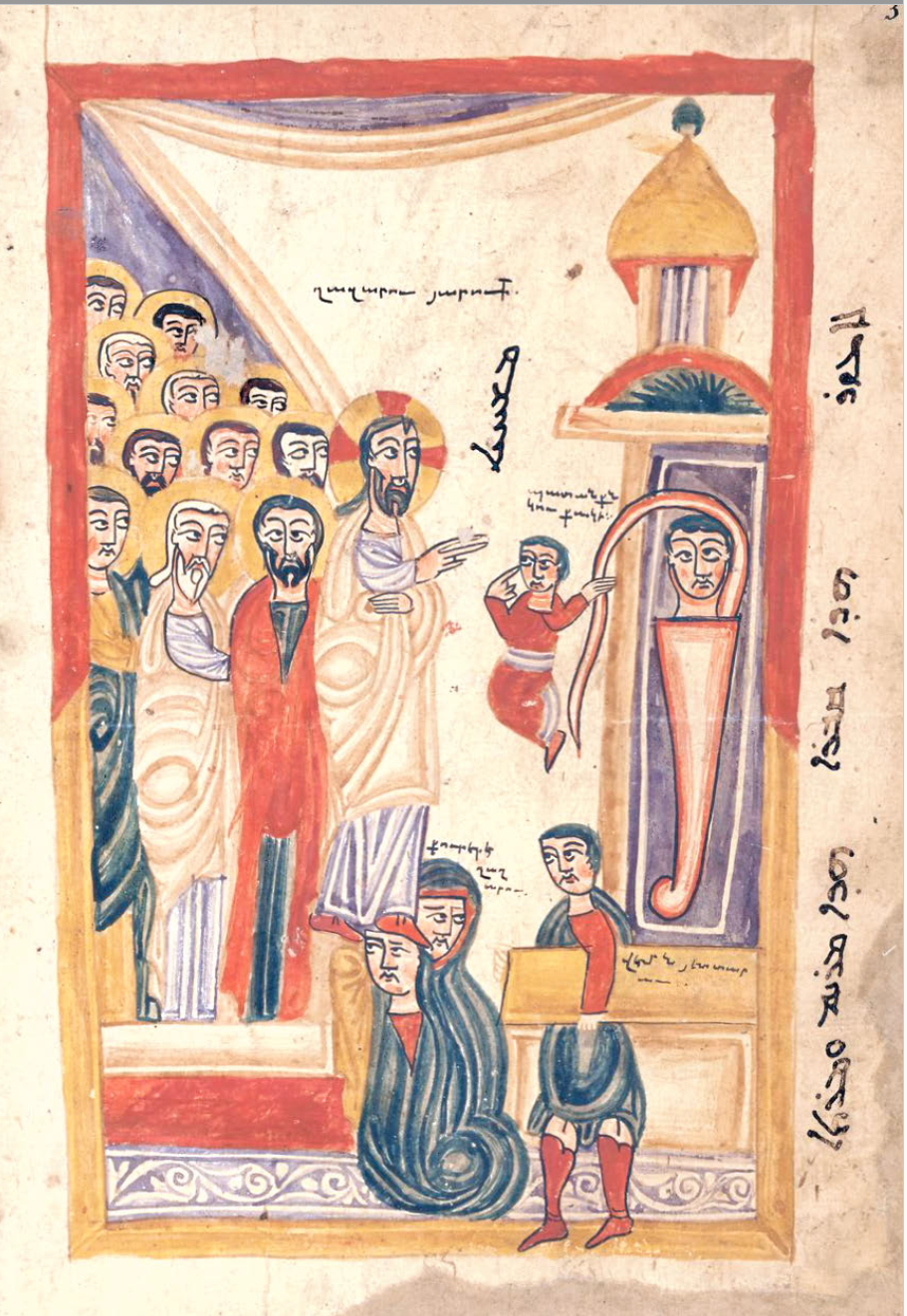
The icon of the Raising of Lazarus (3r) has all twelve disciples together with Christ as Mary and Martha weep at His feet while he blesses with two fingers extended, perhaps with the lower finger partially extended as well (?). Lazarus's soul looks at Christ as it is being called back to his body, with stray bit of shrouding making a connection between the soul and body of the deceased. Below him is the attendant carrying the door of the tomb. The Syriac inscription in the middle says "Christ," while the one outside the frame (from top to bottom) says "Lazarus...this is the tomb...this is Mary and Martha." The divine purple unites the apostles, Christ (his garment is purple as well) and the death-space of Lazarus. Interestingly, the halo of Christ is marked by three red arms of a cross rather than the inscription more typical of Byzantine icons. Generally, these icons seem Byzantine until looking closely and noticing remarkably original elements that mark a separate tradition. I am fairly sure that the iconography purposefully violates the frames of his icons as do the red boots of the attendant here.


As its Syriac inscription says, this is the "Sunday of Hosannas," or Palm Sunday (3v). This time the architectural element is a simple onion domed Jerusalem city wall, with the adults within the wall and a child laying down clothes at the feet of Christ. The Twelve are behind Christ as he rides into Jerusalem. The crowd seems a bit sinister as they hold up their hosanna branches, with the two peering on from above. The stylized palm tree frames a division between Christ and the city. Another onion dome breaks the frame above as does the kneeling and reverent child below.


Finally for this installment of MS 344, the Baptism of Christ by John in the River Jordan (3bis r) has the vertical Syriac inscription "John...Christ...in the Jordan," and the out-of-frame "angel." Christ is in the middle of the river as John baptizes him, though it is Christ's right hand that is blessing. The angel serves as Christ's deacon, holding a receiving cloth, though it is red for Christ is God. The hand of God, again with a two fingered blessing, sends down the Holy Spirit, which here is looking upward. Perhaps it is an intentional representation of the trinity in that the Spirit is not upside down (or descending) to form a vertical Trinity with God the Father (the commanding hand of blessing) and God the Son.

I have twelve more icons to enjoy writing about, and they will be up soon, six at a time. Please do "follow by email" by putting in your email address in the box on the upper right. If you have some insight or observations on these icons, please share in the comments.


Friday, November 23, 2012

Chalcedon in the Assyrian Church: A Third Helping


This is my third and final posting related to the Church of the East’s reception of Chalcedon. I’ve spent a great deal of time on Chalcedon because it allows the canonical tradition to speak for not only the place of this important Christological (theology on Christ) statement in the Church of the East but it also allows us to understand where the Church of the East places herself within the scope of Apostolic Christianity. Therefore, we’re going to conclude our study of this council by examining the way the documents of Chalcedon were received by the Church of the East, as well as stating a few questions that arise from our study of Chalcedon as an Assyrian Church heritage as well a reflection of the larger ecclesiological reality.
The Assyrian Church of the East, according to her canonical tradition, forms her canonical structure as a patriarchal and local church of the one Church of Christ; this is a universal Christian structure. The Collection of Synodical (Canonical) Documents of the Church of the East or the Synodicon of the Church of the East demonstrates this by how it prioritizes its three sections: 1. Canons and Decrees of the Ecumenical (Western) Councils; 2. Canons and Decrees of the Patriarchal (Assyrian) Councils; 3. Letters and Questions and Answers regarded as canonical binding. There is a clear priority in the structure of this document and it reflects the basic self-understanding of a local Church in orthodox faith: what is universal is expressed by what is local. Simply, an ecumenical council accepted by the Church of the East (Nicea or Chalcedon) is superior and structural to the patriarchal councils of the Church of the East (Mar Ishaq or Mar Aqaq).

The Synod of Chalcedon forms the bedrock of Christology for Chalcedonian Christianity and thereby forges the Orthodox identity we know today. It is the last “Western” and Ecumenical Synod entered into the record of the Church of the East. Therefore, it represents the last time that a full and complete sense of Christian unity was shared between the Church of the East and apostolic churches west of Persia—Rome, Constantinople, etc. Of course, it also cleaved ‘one-nature’ Christianity away from ‘two-nature’ Christianity. Chalcedon also offers a powerful statement in response to the central controversy that ended up being the cause of division: how do we speak of Christ as fully God and fully man.

W.A. Wigram, in his awesome book, An Introduction to the History of the Assyrian Church or The Church of the Sassanid Empire 100-640 A.D (full text available here) provides us with the Assyrian version of the Definition of Chalcedon, as found in the Mosul manuscript:
Joining ourselves therefore to the holy Fathers, we all confess alike and with one accord-one and the same Son, our Lord Jesus Christ, perfect in His Godhead,. and, the same, perfect in His Manhood, of reasonable soul and body. Of one nature with His Father in His Godhead, and, the same, of one nature with us in His Manhood, in all things save sin; begotten of the Father before the worlds in His Godhead, and born in these last days, the same, for us men and for our salvation, of Mary the Virgin, Mother of Christ who is God and Man; One and the same Christ, Son, God, Lord Only-begotten; to be acknowledged in two natures without confusion, without change, without mixture, without separation; the distinction of the two natures being by no means done away by the union, but the individuality of either of the two natures being rather preserved, and running together in one Person and two Qnumi; not to be divided or separated into two Sons, but there being one and the same only-begotten Son, our Lord Jesus Christ. (Wigram 297)

Notice two differences from the original form of the Definition of Chalcedon: Theotokos is rendered “Mother of Christ who is God and Man” and the phrase “one person and two qnume” where the original has Theotokos and just “one person”, respectably. The term Theotokos is not used by the Church of the East on grounds that it is unclear rather than strictly theologically wrong. The first reason Theotokos, Yaldath Alaha in Syriac, seems unclear to the Church of the East is that Alaha (God) refers to the God-head or the Trinity so the Church of the East rejected the sense that the Blessed Virgin is the “Mother of the Trinity”. 
Also, Mshikha (Messiah or Christ) is overwhelming defined as the God-man, Jesus Christ. Indeed, in all my reading of Assyrian Christological documents and having chanted through the services growing up, I have never seen Mshikha used in any fashion other than the God incarnate. Therefore, the Assyrian theologians wonder, why would one not prefer the name of the Second Person of the trinity, Mshikha, to the name of the whole trinity, Alaha, when describing whom it was the Virgin bore? Here’s a nice example of Assyrian thinking on the subject:


It is just and right and proper that Mary should be called "Mother of Christ," for that is the name that shows that there was one Person of unity, who in His human nature was of her nature, and in His Godhead, not of her nature. But seeing that from the first moment of the conception of the Manhood of our Lord, that He took from her, God the Word dwelt in it temple-wise and unitedly, and made it with him one Son eternally, we do say that she was thus "Mother of God" and "Mother of the Manhood." Mother of the Manhood by nature; Mother of God, in that He was united to His manhood from the first moment of its conception; and it is His temple eternally, and He is God and Man unitedly, one Son, one Christ (De unione, VII:22; Wigram 288).

Basically, Mother of Christ is preferred for it is seen as encompassing both Mother of God and Mother of Manhood and both latter terms are seen as insufficient. Indeed the term Mother of Manhood, Yaldath Barnasha, was rejected in the AD 612 Synod of the Church of the East as equally objectionable as Yaldath Alaha. Simply, there is an Assyrian Church allergy to phases that could be misinterpreted as eliminating the human nature of Christ. Of course, caution is taken to preserve the sense that Christ is one and that the Messiah is one person: God incarnate.

Furthermore, Chalcedon’s careful expression of Christ as both one person and two natures, with the added and strong emphasis “inconfusedly, unchangeably, indivisibly, inseparably in one person” is reflected in the Christological formulae used in synodical decrees of the Church of the East. The Assyrian Church of the East expresses Chalcedonian theology with great ease. Indeed, the theology and language of Chalcedon is repeated and restated not only in the Synod of Mar Aqaq (as referenced in my prior post), but also those of Mar Isho-Yahb (AD 587); Mar Sabrisho (AD 596); and Grigor (AD 605).

It is intriguing to consider the Christological reality of a Church that accepts Chalcedon (the fourth Ecumenical Synod), but has not responded, officially, to the teachings and canons of the 3, 5, 6 and 7th councils—putting the condemnations of Theodore and Nestorius aside. Would the Church of the East find these councils expressive of what she herself believes? This question is further imposed by the reality of the Synodicon itself. Clearly, the fact that ecumenical councils are given the spot of honor at the head of the document speaks of the ecclesiastical reality that the Assyrian Church saw herself as properly belonging as the Patriarchate of all the East of the Orthodox and Catholic Church. Could this vision of ecclesiological unity expressed in canonical reality be conceived of again, if certain dialogues bore fruit?

Friday, November 16, 2012

Canonical Terms: What are we talking about?


In examining to what extent the Assyrian Church of the East shares common ground with the Orthodox Church, I’ve been using the collection of canonical writings of the Church of the East known as the Synodicon Orientale. I am going to deal with canonical material from the Synodicon Orientale in a more minute way, so I’ll begin with a few definitions of the basic canonical terms I’ll use.

Canonical: Christianity has been attempting organization since the apostles first disputed over who can sit with who at table in fellowship. When Christians first got permission from imperial authorities (the Persian Empire for the Assyrians; the Roman for the Orthodox-Catholic Church), they got to unite in both local and ecumenical or world-wide synods—the Ecumenical Synods all happened under the Roman Christian authority of Constantinople. Ecumenical synods were an outgrowth of the basic and universal Christian structure of bishops who preside over cities and the bishop of the metropolis, around which the other cities share an imperial/secular economy and government, uniting with his fellow bishops from time to time to order Christian life in common. The meetings were called synods, meaning “walking together”. The local synods of the first couple centuries gave rise to imperially supported Ecumenical Synods after the conversion of St Constantine the Roman Emperor.

When something required a group of bishops to deliberate, they gathered and came up with a statement or even a set of commonly accepted rules (canons). This statement, with the canons that might accompany, becomes the expression of the will of the Holy Spirit for the body of the church that proclaimed it. Now, if we’re considering a decree and/or canons of a local council of the Church of the East (Synod of Mar Aqaq, for instance), then we know that decree is particular to the Church of the East.

Similarly, when we consider a decree of an Ecumenical Council, we know that this affects the entire ecumenical (worldwide) Church. It also means that if someone does not accept it as ecumenical while another church does, they now have a fundamental division; schism or heresy. Now a canon of the synod of the patriarchate of Antioch very much will affect the entire Church of Antioch, but if Russia disagrees, it doesn’t matter since it is an Antiochian canon. If everyone adopts the decisions of a particular synod, then it becomes, by use, ecumenical. Most decrees and rulings are the local administration of a local church—Antioch, Alexandria, Russia, Georgia, or the Church of the East. Some synods are ecumenical because they are accepted by the entire church: Nicea, Constantinole, etc.

Canonical denotes material recognized as the binding and expressed will of the Holy Spirit. Canonical material is binding in a way other documents are not. You can disagree with a point of St John of Damascus (Angels cannot repent because they do not have bodies) and still be an obedient Orthodox Christian of the Patriarchate of Antioch, but you cannot be violating the canonical decrees of that Patriarchate of Antioch (celebrate Christmas on 25 December) to which you belong. The Scriptures are the fundamental canonical material of Christianity as is the Nicean Creed. There are other less well known ecumenical documents such as the Apostolic Canons or the Canons of Laodocia that are also ecumenical. Of course, Christians the world over will have a bible and recite the creed. They won’t however, usually, be dealing with Episcopal discipline or other canonical issues, so some parts of the canonical tradition are more well-known than others.

Synodicon: A synodicon usually means a decree or summary and authoritative statement of a Synod, such as the Synodicon of Orthodoxy . Or it can also mean a book that contains the material of the synods that are considered binding on a particular jurisdiction. An ecumenical synodicon would be everything universally binding while a Russian, Greek, Church of the East or Roman synodicon would be stuff that is binding on the local church. Of course, the ecumenical canonical material has priority over the local canons that usually are trying to fine-tune the purpose of the ecumenical canons. For example of an old ecumenical synodicon and what the word represents read up on the Vetus Synodicon.

The Synodicon of the Church of the East is a term I use to refer to a massive collection of everything considered canonical in the Church of the East at the time of the particular manuscript’s writing. However, in the 13th century the main texts of the synodicon were compiled and edited in one volume; as far as I know, they haven’t been since. We’re working with a document that is from the 13th century, so bear that in mind. This document is the expression of the will of the Holy Spirit to the Church of the East and speaks for the Church’s self-understanding in as serious a fashion that her liturgy does.

Now a word about editing. How important would the second article of the US Constitution be without the Constitution itself, just as a stand-alone document? It would be a nice opinion but defiantly not binding. Canon Law is as much a history of how the Church structured herself as it is a history of what made-up that structure. Imagine the books of the bible mixed in with every other ancient writing that vaguely spoke of Christ rather than the particular sequence and priority structure we have due to the Church’s careful work in the first centuries.

Now canons have been collected together ever since Nicea created the sense of a united Christendom. At first, there was a Corpus Canonum, or Body of Canons from Antioch which just had all the canons and decrees of the councils then accepted as authoritative; it probably had its origins in Antioch. This Corpus or body of canons was continually growing from around 350 until around 520; it thereafter morphed in to Syntagma and Nomocanon, which are beyond the scope of this entry. During this time, an early edition was taken to the Church of the East by St Marutha of Maperqath. From the time of Mar Marutha, the Church of the East receives various editions of the documents of the ecumenical councils of the “western fathers”, which is how she saw her Antiochian, Constantinopolitan, etc brethren.

Now, Mar Marutha simply began the process of the Church of the East accepting those canonical documents which the rest of Christianity accepted. Since his time, there were several updated editions of the ecumenical synods that were received, as you can see in my prior post. For instance, Mar Yahbalaha in 420 geso so far as to furnish an actual request of the patriarch and synod the Church of the East for the Persian emperor to furnish them with texts of the canonical material of their western brethren.

Eventually, the documents of the Ecumenical Synods, or Corpus Canonum, is enlarged for the particular use of the Church of the East by the addition of the documents of the Patriarchal Synods and also a body of authoritative letters and responses. This great body of canonical material is collected in the eight and again in the thirteenth centuries to produce the basic collection of everything considered explicitly canonical in the Church of the East. This collection of canonical material is what we are dealing with in our investigation and it is that document that will be called Synodicon Orientale or the Synodicon of the Church of the East.

Next I will deal with the particular way Chalcedon was accepted into the canonical material of the Church of the East. Given that everyone might not be as familiar with the basic concepts of canon law, I penned this entry to provide some definitions. I hope to post my final entry on Chalcedon in the next few days as it is mostly written.  


Monday, October 8, 2012

Who do you say that I am, Part II: Reception of Chalcedon

The mark of true faith for the Orthodox Churches is the faith of the “Seven Ecumenical Councils” that met between AD 325 and AD 787. For Orthodoxy, as well as the Roman Church, the Ecumenical Council at Chalcedon in AD 451 produced the most enduring creedal statement regarding the person of Christ and is regarded as the touchstone of correct belief. Therefore, the Church of the East accepting and confessing the faith of Chalcedon - its creedal formula as well as the canons put forth in the council - would be a powerful statement of theological closeness between the two churches.

The Decree of Chalcedon expresses the Church’s faith in Christ who is divine and human; two natures united, without division, confusion, separation or change, in one person. Earlier, I posted regarding the Decree of Chalcedon in regard to the first ‘in house’ decree of the Church of the East, The Synod of Mar Aqaq. To read the Decree of Chalcedon as well as a later sample of how the Church of the East digested the meaning of Chalcedon, please see my earlier posting here.
The statements, canons and decision of councils that are accepted by the Church of the East are found in a book named the Synodicon Orientale, which was published by J.B. Chabot in 1902 under the title Synodicon Orientale ou Recuel de Synodes Nestoriens [=SO]. The full Synodicon of the Church of the East has three parts: The Councils of the Westerners (meaning local and ecumenical councils considered authoritative at the time of Chalcedon); the Collection of the Thirteen Patriarchal Synods (of the Church of the East); various letters considered authoritative. Chabot gives us the second part only, the Collection of the Thirteen Patriarchal Synods, and he provides a list of the contents of parts one and three, from which we can hunt down the content, somewhat successfully. It would be a blessing if the Church of the East would print an authoritative Synodicon, in Syriac at least, if not also a careful English translation.

Back to the point - the Assyrian Church of the East accepted Chalcedon as an Ecumenical Council. In J.B. Chabot’s 1902 edition, Synodicon Orientale, there are several expressed statements of the Council of Chalcedon as an accepted council of the Assyrian church. Here are two clear references from the Synodicon of the Church of the East (translations mine):

“The Enumeration of the Books of Canons [Synodal Statements]  which the Church of the East accepts, conforms to, and keeps. Western and Eastern Synods: Apostolic Canons of the Fathers: which are accepted by and by which functions the Holy Apostolic Orthodox Church:

1.    Canons of the Holy Apostles: 21 Canons

2.    Again Those of the Apostles: 81 Canons

3.    Of the Twelve Apostles: 7 sections

4.    Synod of Anqura [Ancyra]: 24 canons

5.     Synod of neoqesarya (Neocaesaria): 14 canons

6.    Synod of Niqia (Nicea): 20 canons

7.    Universal Synod: 73 Canons

8.    Synod of Gangra: 20 canons

9.    Synod of Antioch: 25 canons

10. Synod of Ladyqia: 59 canons

11. Synod of Contantinopolis: 4 canons

12. Synod of Chalcedon: 21 canons.(SO 610)"
Notice that the 12th recognized synod is Chalcedon and is received among the “Eastern and Western Synods”, which is an indication of the ecumenical content of these documents. The Church of the East is explicitly expressing her Orthodoxy in conforming to these canons. Historically speaking, there was a body of canonical material, called the Syntagma Canonum Antiochenum, which was the master collection of canonical material of the ecumenical era. Sometime around AD500 it was translated into Syriac in Mabbug and did not contain Ephesus or the 85 Apostolic Canons until later in the sixth century. It seems that this Syntagma Canonum Antiochenum is what the Church of the East has as the first part of her canonical material.

Also, in the same Synodicon Oritentale of the Church of the East is found the proclamation of the synods accepted by the Church of the East at the time of Mar Awa the patriarch and he reiterates Chalcedon as among the synods the Church of the East sees as ecumenical: “Again, the declaration that was ordained by Mar Awa Patriarch and the Bishops gathered with him…Those of the Synod of the five hundred and sixty seven bishops gathered in Chalcedon” (SO 545) 
For Orthodoxy, the consideration that the Church of the East accepts Chalcedon proposes a new perspective of the Assyrian Church. This does not do away with the question of Nestorius or Theodore of Mopsuestia; however, it does mean that these two churches share Chalcedon as a point of common ground. As the touchstone of Orthodox Christology, the common expression of Chalcedon means that these two Churches certainly have enough to dialogue about. It does not mean, however, that issues such as the condemnation of Nestorius and Theodore of Mopsuestia or the Council of Ephesus are not serious points of contention. Next we will deal with how the text of Chalcedon is preserved in the Church of the East’s documents. What we will be dealing with over the lifetime of this blog is whether Chalcedon is received, interpreted and taught with the same end result in both the Orthodox Church and the Church of the East.